
Supreme Court Ruling Shatters TPS Protections & Asylum Access
On June 25, 2026, the Supreme Court of the United States (SCOTUS) issued decisions in Mullin v. Doe and Trump v. Miot, ruling that lower courts do not have legal power to review or block the government’s decisions to end Temporary Protected Status (TPS) for individuals from Syria and Haiti. As a result, hundreds of thousands of long-term residents are at immediate risk of losing lawful status and work authorization. On the same day, the Supreme Court issued a decision in Mullin v. Al Otro Lado, gutting processing requirements for individuals at ports of entry. The ruling leaves vulnerable people stranded at the Mexican border, putting lives at risk and potentially incentivizing riskier alternative entry methods.
The National Network for Immigrant and Refugee Rights (NNIRR) condemns these decisions which together severely restrict judicial oversight, drastically eroding asylum access and humanitarian protections both at U.S. borders and nationwide.
TPS Case Overview
TPS was created by Congress to allow individuals already present in the United States to remain temporarily while conditions in their home countries make safe return impossible. The case of Mullin v. Doe concerned the termination of TPS for Syrian nationals. Syria was designated for TPS in 2012 due to ongoing armed conflict and life-threatening conditions arising from the Syrian civil war. After DHS announced its decision to terminate Syria’s TPS designation, Syrian TPS holders filed suit arguing that the decision violated the Administrative Procedure Act.
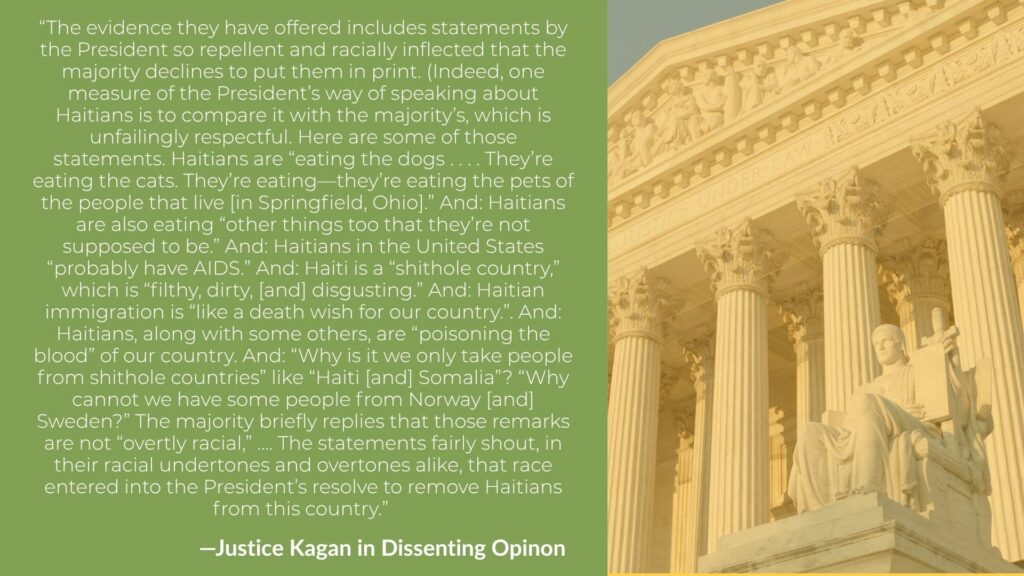
The case of Trump v. Miot involved the termination of TPS for Haitian nationals. Haiti was first designated for TPS in 2010 following a catastrophic earthquake and ongoing political and humanitarian chaos. Haitian TPS holders challenged the government’s decision to end the designation, arguing that it violated the Administrative Procedure Act and that it was motivated by racial discrimination in violation of the Equal Protection Clause.
The Supreme Court interpreted that lower courts cannot review TPS termination decisions, effectively destroying a crucial line of defense for migrants facing deportation.
Asylum Case Overview
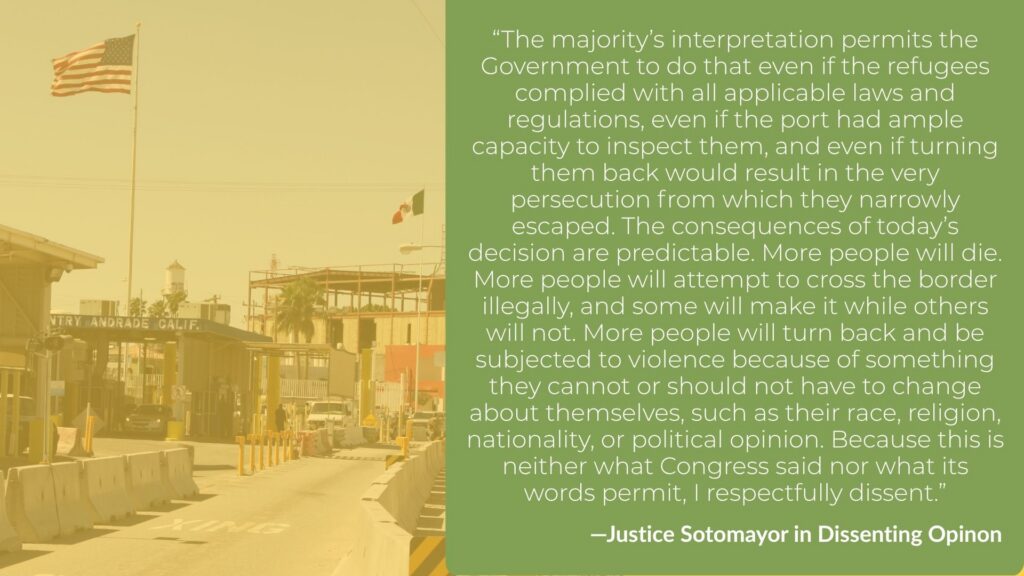
In a separate decision (Mullin v. Al Otro Lado), SCOTUS restricted access to humanitarian protections for people seeking safety at the U.S. border. This case considered whether individuals stopped at the border before entering the United States have a legal right to seek asylum protections. Challenging a policy known as “metering”—which limits the number of migrants allowed to cross the border daily—immigrant rights groups sued the U.S. government for turning asylum seekers away at ports of entry and forcing them to wait in Mexico.
Historically, presenting oneself at an official port of entry was the standard, lawful way to seek refuge. However, the Court’s conservative majority ruled that the Refugee Act of 1980 and the INA only grant asylum protections to individuals who have physically crossed onto U.S. soil. The ruling reversed the Ninth Circuit’s earlier decision, which had affirmed that asylum seekers encountering U.S. officials while waiting in Mexico were legally in the process of “arriving” in the United States
Because waiting at an official port no longer guarantees a legal hearing, it incentivises people to seek out alternative – more dangerous – terrain to trigger their legal asylum rights on U.S. soil. Additionally, forcing thousands of asylum seekers to wait indefinitely on the Mexican side creates an immediate humanitarian crisis for Mexican border towns.
The Court has essentially given future presidential administrations a roadmap to avoid asylum obligations entirely. By altering the definition of what it means to “arrive” at a border, the U.S. is signaling to the rest of the world that wealthy nations can bypass their moral and international obligations to asylum seekers through geographic loopholes
NNIRR Condemns SCOTUS Rulings
The Court’s decisions come at a moment of growing instability and attacks on the rights of immigrant communities. Stripping away protections like asylum, TPS, and DACA, are not separate issues; they are part of a larger, comprehensive strategy to force migrants of color to return to countries where danger, poverty and insecurity are the way of life. These decisions remove necessary legal review and prevent communities from challenging government decisions, destabilizing families, workplaces, and our nation.
NNIRR will continue standing with TPS holders, asylum seekers, and immigrant communities in the fight for permanent protections.
Take Action
NNIRR urges you to voice your opposition to these attacks on our immigrant neighbors by:
Call Your Senator
Demand they pass S. 4814— the legislation requiring the Secretary of Homeland Security to designate Haiti for Temporary Protected Status (TPS)— without delay.
Sign Petition
Tell Congress to act now to protect immigrants and asylum seekers