
The Promise of Birthright Citizenship Endures
On June 30th the Supreme Court released their decision in the case of Trump v. Barbara, widely referred to as the Birthright Citizenship case. The Court upheld the precedent that any child born within the territory of the United States is a U.S. citizen, regardless of their parents’ immigration status. The decision struck down President Trump’s executive order to deny citizenship to children of undocumented immigrants and temporary visa holders.
NNIRR affirms that birthright citizenship is a Constitutional right—not a political privilege that can be granted or revoked by presidential decree. For generations, birthright citizenship has promised protection against discrimination and exclusion, ensuring citizenship cannot be denied on the basis of race, ancestry, or parents’ immigration status and safeguards against attempts to discriminate against non-white immigrants.
History of Birthright Citizenship
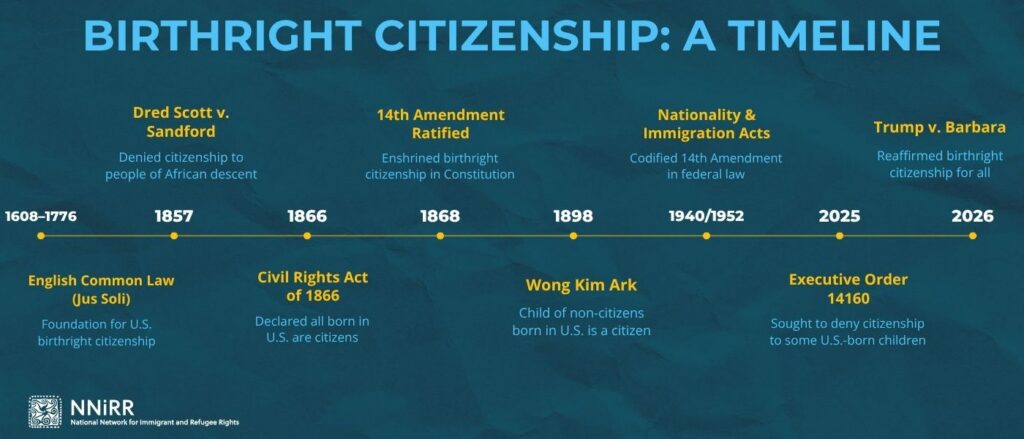
Birthright citizenship is rooted in the Citizenship Clause of the Fourteenth Amendment, which states that “all persons born or naturalized in the United States, and subject to the jurisdiction thereof, are citizens of the United States.” Ratified in 1868 following the Civil War, the Amendment established a clear constitutional guarantee that citizenship is determined by birth within the United States—not by race, ancestry, or the immigration status of one’s parents.
The Amendment was adopted in response to the Supreme Court’s infamous Dred Scott decision, which denied citizenship to Black Americans and their descendants. By enshrining birthright citizenship in the Constitution, Congress sought to ensure that no future government could arbitrarily deny people membership in the nation. Again, in 1898, the Court’s landmark decision in United States v. Wong Kim Ark reaffirmed that a child born in the United States is a citizen under the Fourteenth Amendment even when their parents are not U.S. citizens.
Birthright Citizenship is a Constitutional Right
Birthright citizenship is rooted in the Citizenship Clause of the Fourteenth Amendment, which states that “all persons born or naturalized in the United States, and subject to the jurisdiction thereof, are citizens of the United States.” Ratified in 1868 following the Civil War, the Amendment established a clear constitutional guarantee that citizenship is determined by birth within the United States—not by race, ancestry, or the immigration status of one’s parents.
The Amendment was adopted in response to the Supreme Court’s infamous Dred Scott decision, which denied citizenship to Black Americans and their descendants. By enshrining birthright citizenship in the Constitution, Congress sought to ensure that no future government could arbitrarily deny people membership in the nation. Again, in 1898, the Court’s landmark decision in United States v. Wong Kim Ark reaffirmed that a child born in the United States is a citizen under the Fourteenth Amendment even when their parents are not U.S. citizens.
Take Action
Call Your Senator
Even though SCOTUS has upheld Birthright Citizenship, conservative legislators are continuing to push legislation that would strip away this right from the children of immigrants. We urge you to call your Congress Representatives and Senators to demand that they vote against The Birthright Citizenship Act (H.R. 569), The Assimilation Act, and The Anchors Away Act.
Support our Partners
Donate to the ACLU’s, Defending Our Neighbors Fund, and the National Immigration Law Center to support impact litigation aimed at defending the 14th Amendment and immigrant families across the country.