How Federal Enforcement Funding Undermines Our Communities
August 6, 2026
Jane Antonio & Amelie Resendiz
The passage of the 2025 ‘Big Beautiful Bill’ highlighted significant taxpayer spending on border militarization, though it was neither the first instance nor the largest amount of federal funds dedicated to immigration enforcement.
Back in 2005, the U.S. Department of Homeland Security launched Operation Stonegarden (OPSG) which directs federal grants to local law enforcement agencies operating along the nation’s borders.
Over the last two decades, millions of federal dollars have been allocated to expand the reach of immigration enforcement to the local police level. The impacts of Operation Stonegarden extend beyond a misuse of federal funds, it disproportionately endangers immigrant communities and undermines the safety of those living in border regions.
The National Network for Immigrant and Refugee Rights (NNIRR) has long opposed the criminalization of migrants and immigrants and the relentless allocation of more and more tax dollars into enforcement strategies, including the incentivizing of local law enforcement to take on federal enforcement roles. OPSG fuels fear, weakens community trust, expands surveillance, and diverts funds away from critical community investments. It has not stopped the migration of desperate people.
What is Operation Stonegarden?
Operation Stonegarden is a Homeland Security Grant Program (HSGP) administered by the Federal Emergency Management Agency (FEMA). It provides funding to state, local, tribal, and territorial law enforcement agencies at the border to cooperate with and support Customs and Border Protection (CBP) tactics.
Local agencies use these funds for: operational expenses, overtime, surveillance technology, new vehicles, travel and deployment costs. This year, the Homeland Security Grant Program (HSGP) was granted $1.064 billion to fund 3 programs the State Homeland Program (SHSP), the Urban Area Security Initiative (UASI), and Operation Stonegarden.
In 2026, OPSG’s total program appropriation is $85.5 million, an increase from $81 million in 2025. Official data on county funding will be released in September, but here is what we do know: Operation Stonegarden is more than a grant program. Every new agency that accepts OPSG funds becomes another point of contact where immigrant families are subject to immigration enforcement. It means an increased threat of unjust surveillance, detention, and agents who reach into schools, workplaces, neighborhoods, and the public institutions communities rely on every day.
Impacts of Intertwined Enforcement
Public safety cannot exist where entire communities fear those sworn to protect them. When local law enforcement becomes part of the immigration enforcement apparatus, the line between community policing and immigration enforcement disappears. Immigrants will avoid reporting crimes, or seeking medical care, or calling for emergency assistance out of fear that contact with local authorities is a risk.
RESEARCH SPOTLIGHT:
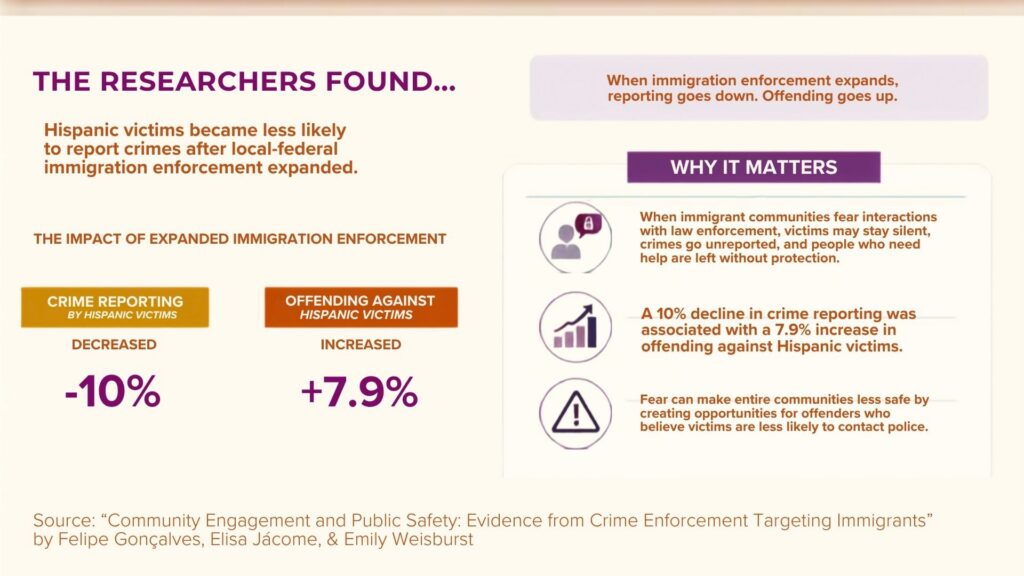
Researchers found that, in communities where there was increased collaboration between local law enforcement and federal immigration authorities, fear of deportation increased, and Hispanic victims became less likely to report crimes to police. The study estimates that every 10% decline in crime reporting led to a 7.9% increase in offending against Hispanic victims. Overall crime reports appeared unchanged, masking the fact that crimes against Hispanic communities increased while victims became less likely to seek help from law enforcement. The lesson is clear: when immigrant communities fear interactions with law enforcement, everyone is less safe.
Operation Stonegarden also raises urgent questions about accountability because safeguards to prevent racial profiling, or civil rights violations are non-existent. As more local departments are drawn into immigration enforcement, the opportunities for discrimination, excessive force, and unconstitutional policing grow.
Across the country, immigrant communities have documented the consequences of increasingly intertwined local and federal enforcement.
SPOTLIGHT: Melendres v. Arpaio
Arizona's Maricopa County is an example of what can happen. Under former Sheriff Joe Arpaio, deputies conducted large-scale immigration patrols that disproportionately targeted Latino communities. In 2013, a federal court found that the Sheriff's Office had engaged in unconstitutional racial profiling of Latino drivers. Hispanic residents were stopped and detained because of their suspected immigration status.
Expanding the reach of enforcement has not solved the drive for migration, nor has it made communities any safer which is the primary duty of local police — it only deepens the divide between local police and the communities they are supposed to protect. It creates fear in the community, separates families, and places more lives at risk
Action
As a community, we must come together to stop the devastating impact that enforcement is having on our lives.
Student Action Against OPSG
Earlier this year, 100 students at University of California San Diego (UCSD) protested the UCSD Police Department ‘s use of Operation Stonegarden funds.
They argued that cooperation with federal enforcement agencies created an unwelcoming environment for immigrant students on campus. “Blood is shared between us not borders” and “No more detention, no more fear, ICE off campus, make it clear” they chanted.
Operation Stonegarden dollars expanded surveillance cameras and increased immigrant enforcement on campus heightening fear and undermined students’ sense of security. At UCSD, students advocated for preserving trust between the university, students and the wider community.
Call Your Representatives
Contact your Congressional representatives to demand that they defund Operation Stonegarden and advocate for legislation like:
Senate Bill 54 (The California Values Act) prohibits California law enforcement agencies from using local funds or personnel to investigate, detain, or assist in federal civil immigration enforcement. It bans routine notification and transfers to ICE, it includes strict exceptions allowing cooperation if the individual in custody has been convicted of specific serious or violent felonies.
Illinois (The TRUST Act & Way Forward Act) state law that severely restricts local police from detaining anyone solely based on an ICE detainer or administrative warrant. The state’s subsequent legislation further phased out county jail contracts used to house federal immigration detainees, completely barring local jurisdictions from operating private civil detention facilities.