
Voices from the Borderlands: No Border Wall
The National Network for Immigrant and Refugee Rights (NNIRR) condemns the desecration of indigenous territories and ecologically sensitive borderlands under the false guise of national security. The border wall has never been a solution to forced migration. It has resulted in greater and greater violations of human rights, harm to border communities, and the destruction of the environment, sacred tribal lands and private property. In addition, it is a total waste of our tax dollars. These destructive projects must end now. We demand that our elected representatives act immediately to prioritize human dignity, honor tribal sovereignty, and protect natural ecosystems
Elsa Hull’s Fight for San Ygnacio
On June 4th, an elderly landowner near the Rio Grande watched as federal contractors destroyed trees and bulldozed through irrigation lines on his property to expand the border wall in San Ygnacio. He rightfully refused to sign right-of-entry forms requested by federal authorities. Nonetheless, Southwest Valley Constructors and Kiewit Corporation, contracted for this project, commenced bulldozing through his private land anyway.
“This is not federal property. This is not under the control of the International Boundary Water Commission,” said Elsa Hull, a neighbor and former state environmental investigator who rushed to the scene. Hull’s first arrest occurred during this June 4th incident when she bravely stepped in front of the active machinery to block the bulldozers from further destroying her neighbor’s land. She did this with the owner’s full legal permission to protect his property. Law enforcement unjustly cited her for criminal trespass on a traverse boundary.
Weeks later, Hull was arrested a second time on August 14th during a peaceful demonstration at the county-owned San Ygnacio Bird and Butterfly Sanctuary. Hull went to the public park to film the ongoing activity and hold the construction crews accountable, demanding proof of their legal authority to survey the sanctuary. Local authorities retaliated by taking her into custody on a criminal trespass complaint, claiming she crossed into an excluded project zone, when in reality she was arrested without warning simply for protecting the sanctuary from being disturbed by border wall construction contractors.
Hull is an environmental activist focusing on water-quality and a member of the No Border Wall Coalition. Her two arrests highlight the intensifying legal risks faced by local residents as federal projects override both private property rights and public conservation lands.
Resisting the Wall
Other battles against the border wall are taking place:
BIG BEND NATIONAL PARK
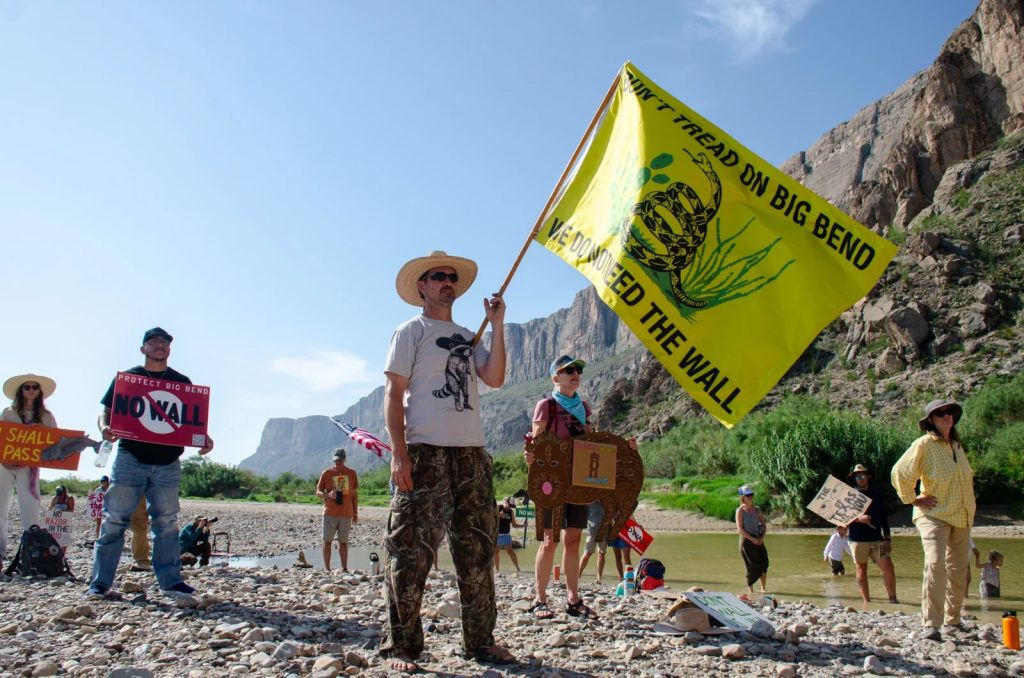
In early August 2026, Southwest Valley Constructors Co. (with $1.72 billion in federal funds) began clearing land near Santa Elena Canyon in Big Bend National Park. This project includes not only physical barriers but patrol roads, surveillance technology and other infrastructure. On August 14, People of La Junta for Preservation, a nonprofit dedicated to preserving Indigenous sites, and two Indigenous worshippers of Lipan Apache lineage sued the U.S. Department of Homeland Security to halt construction and surveying activities in Big Bend. The wall threatens access to sacred sites and ecosystems that are fundamental to Apache religious practices and violates the Religious Freedom Restoration Act and American Indian Religious Freedom Act protections. To the plaintiffs, the land and river are living beings and relatives, and the river connects them to their ancestors
UPDATE: In a major victory, advocates came together to make federal courts temporarily block border wall construction in Big Bend National Park on Friday, October 2, 2026. This ruling halts the $1.7 billion infrastructure project while legal battles continue over environmental damage and Indigenous sacred sites.
THE TOHONO O’ODHAM NATION

In the San Rafael Valley near Lochiel, Arizona, a grove of 200-year old historic Fremont cottonwoods are being destroyed. On July 27, three of four trees were cut down to make room for a double-layer, 27-mile border wall. Conservationists and local residents climbed into the last remaining cottonwood to prevent it from being destroyed. They were joined by residents of the Mexican side of the border. Protesters assert that ecosystems, wildlife and human nature do not follow political lines between nations.
The federal government asserts that these measures increase border security and provide agents with greater operational control. But in a fragile ecosystem, removing centuries-old trees eliminates habitat and food sources that wildlife depends on.
SAN RAFAEL VALLEY
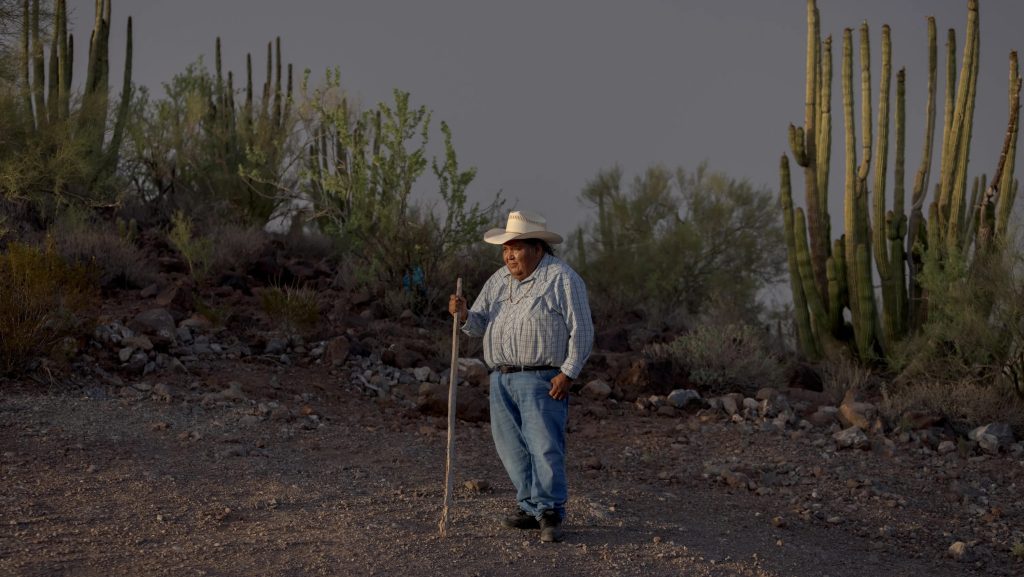
The Tohono O’odham Nation, a federally recognized sovereign Tribal Nation whose reservation extends along 62 miles of the Arizona-Mexico border, sued DHS in June to stop plans for a double-layer, 30-foot-high border wall across its reservation. The Nation argues that taking reservation land and water for the project violates tribal boundaries and sovereignty and is trespassing. The proposed wall would also “fray the ties between O’odham communities and families on opposite sides of the border, interfere significantly with O’odham religious rituals and practices, and destroy plant and animal resources sacred to the O’odham.”
UPDATE: U.S. District Judge Richard Leon denied the emergency injunction on August 13, 2026, ruling that a 1907 federal border buffer zone takes legal precedence over the tribe’s current reservation boundaries.
Funneling Migrants into Deadly Terrain
The humanitarian consequences of these barriers are intentionally lethal. By blocking urban and historically accessible routes, border wall infrastructure forces migrating individuals and families into the most treacherous, isolated corridors of the desert and rugged mountains.
This deliberate funneling strategy relies on extreme terrain and harsh weather as a natural deterrent. Instead of stopping migration, it has resulted in a devastating spike in preventable migrant deaths from dehydration, exposure, and exhaustion. The wall does not secure the border; it simply drives human beings into deadly environments, compounding an ongoing humanitarian crisis
Action
Join the Local Resistance: Elsa Hull is asking for people to show up directly at the San Ygnacio Bird and Butterfly Sanctuary to stand in solidarity and protect the land. “This land still belongs to the people. People need to come out and support… for however long.”
Take Political Action: Contact your Congressional, State, and local elected representatives to demand an immediate end to border wall construction, the dismissal of charges against peaceful protectors, and the restoration of community lands.